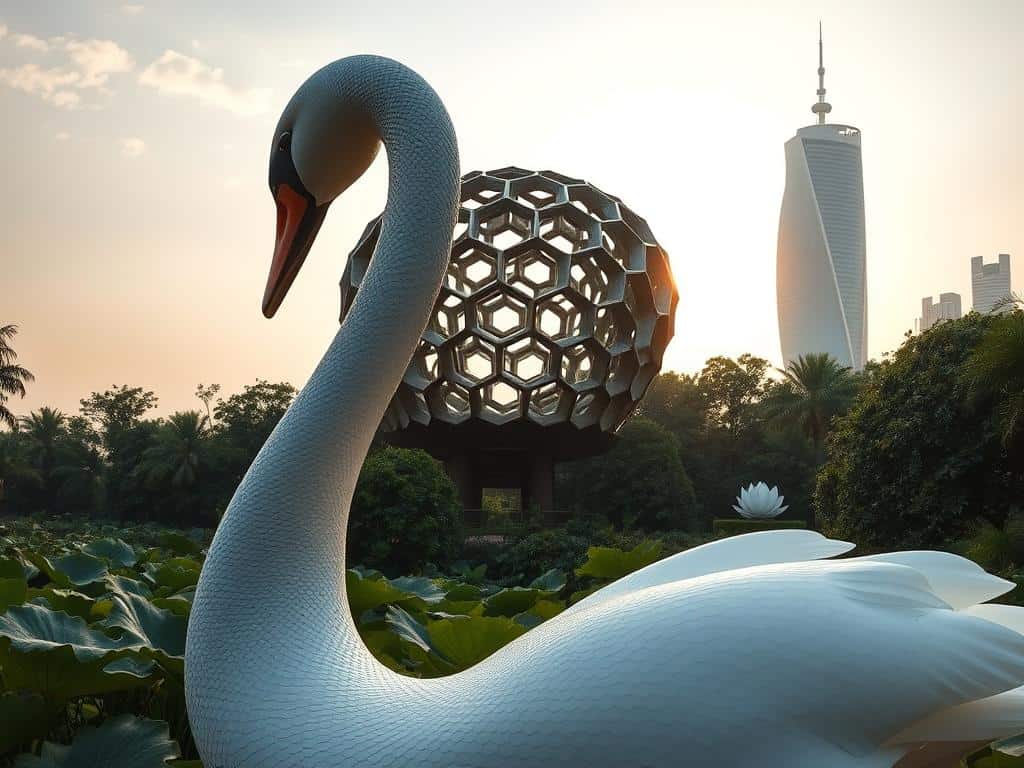
Biomimicry: How Nature Inspires Revolutionary Designs
Walking through a forest, I’m amazed by nature’s designs. These have been perfected over millions of years. It’s humbling to think that solutions to our problems might be hidden among the leaves.
Biomimicry in design is more than creativity. It’s a deep connection between human innovation and nature’s wisdom. It encourages us to use nature’s adaptations to solve today’s big challenges, like energy and sustainability.
Janine Benyus is a leader in this field. She shows us that natural innovation is key for a sustainable future. Imagine creating solutions by learning from the very organisms that have thrived on Earth for ages.
It’s time for us to design in a way that nature understands. Let’s use nature’s genius to build a better world.
Key Takeaways
- Biomimicry promotes sustainable solutions through natural innovation.
- Nature has solved complex problems over millions of years.
- Studying biological systems can lead to efficient and resilient designs.
- Interdisciplinary collaboration enhances innovation in biomimicry.
- Biomimetic designs can significantly reduce environmental impact.
Understanding Biomimicry and Its Principles
Biomimicry is about learning from nature to solve human problems. It comes from the Greek words for life (‘bio’) and imitation (‘mimesis’). This approach looks at biological systems for new ideas, focusing on sustainable design.
The core of biomimicry is based on several key principles. These principles help us learn from nature’s success. The first framework had nine principles from Janine Benyus’s “Biomimicry: Innovation Inspired by Nature.” Later, more than 3.8 billion years of evolution led to twenty-six principles.
Three main principles are key: Emulate, Ethos, and Reconnect. Emulate is about observing nature’s solutions. Ethos focuses on ethics in sustainable design. Reconnect encourages a strong bond with the environment. These principles inspire innovation and highlight our duty to sustainability and growth.
Biomimicry in Design: Inspiring Innovations Across Industries
Biomimetic designs are changing the game in many fields. They use nature’s secrets to solve big problems. For example, a new mixing tech cuts energy use by 30% by copying nature’s spiral flows.
The iThrone toilet is another cool example. It gets rid of 95% of sewage by using a tree-like process. This shows how nature can help solve big issues like waste.
Building materials made from mycelium are also a big deal. They cut down on waste and make buildings greener. This is a huge step forward for construction.
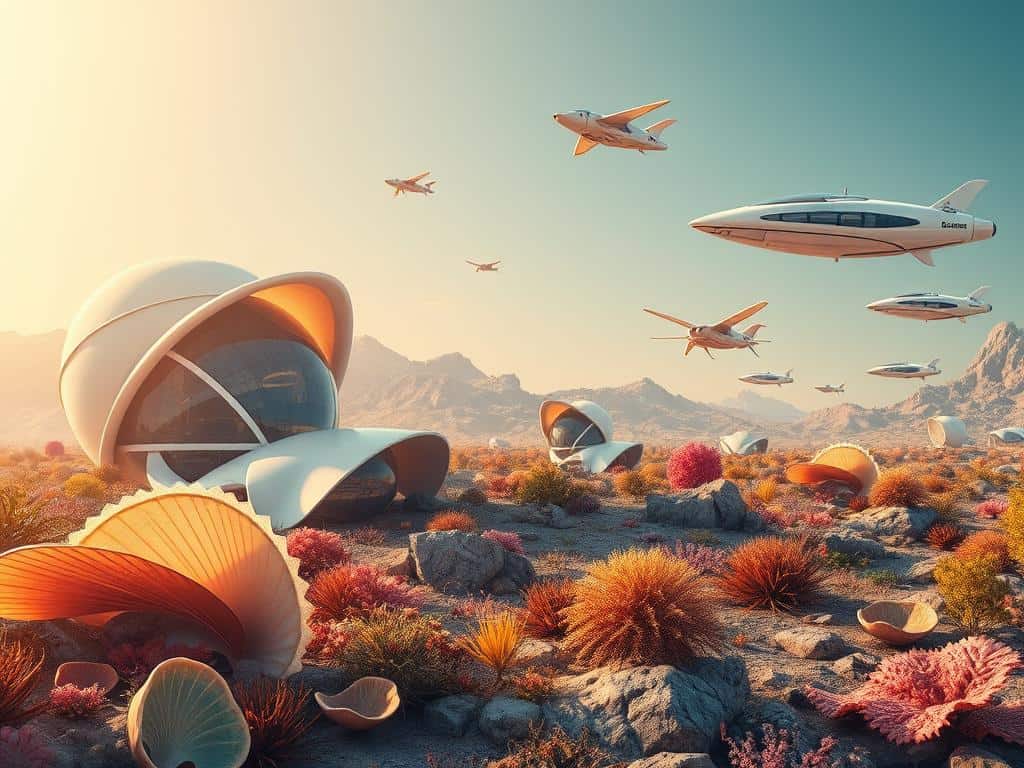
Self-healing concrete made with bacteria could save billions. And underwater adhesives inspired by mussels are getting stronger. These examples show how biomimicry can make things better.
Technologies like aquaporins are making water filtration more efficient. And a new needle design inspired by mosquitoes makes shots less painful. These are just a few ways nature is helping us.
As we keep exploring biomimicry, we see its power. It’s all about using nature’s wisdom to make things better. This approach is leading to a greener, more efficient future in many areas.
Conclusion
Nature is a treasure trove of new ideas. Biomimicry shows us how to use these ideas to make our world better. It helps us design in ways that are good for both people and the planet.
For example, buildings like the Gherkin and the Eastgate Centre use nature’s wisdom. They show us how to build in ways that save energy and reduce waste. This is just the start of what biomimicry can do.
By looking to nature, we can find new ways to solve old problems. The bullet train, for instance, is faster and uses less power because of its design inspired by the kingfisher. This shows how nature’s ideas can make a big difference.
Using biomimicry means we can make things that work better and are kinder to the earth. It’s a way to respect and care for our planet. By following nature’s lead, we can build a future that’s both sustainable and successful.

Leave a Reply
You must be logged in to post a comment.