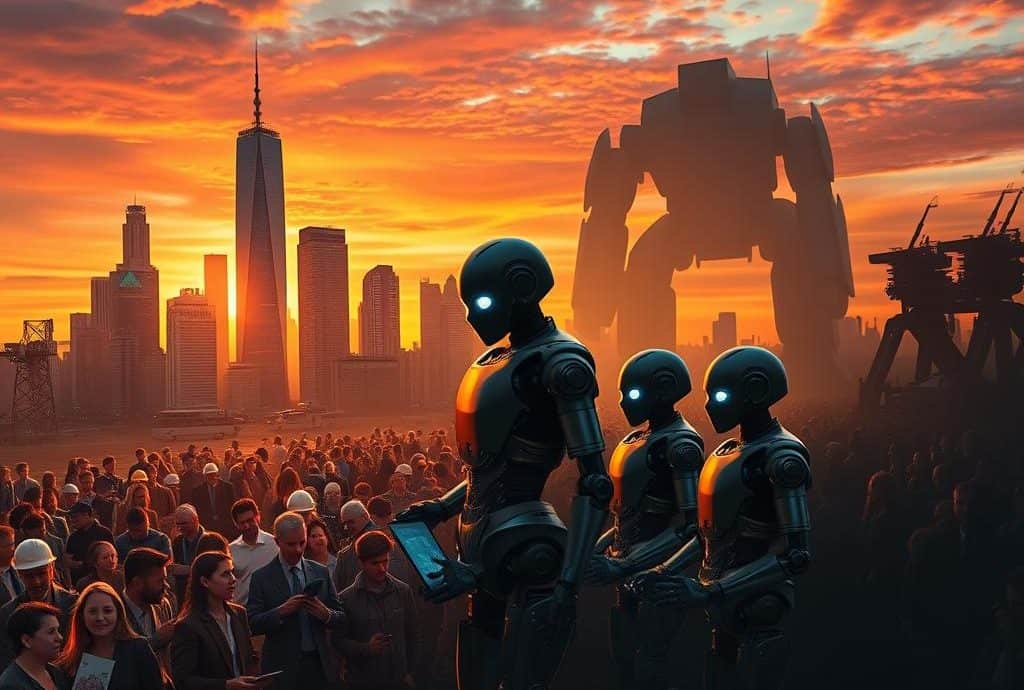
How AI is Changing Jobs Faster Than You Think
Looking back on my career, I see a big change thanks to technology, like artificial intelligence. Job security used to be a sure thing, but now it’s not. AI is changing jobs fast, with a Goldman Sachs report saying it could replace 300 million jobs worldwide.
This news makes us think about our roles and skills in a new world. It’s not just about machines doing our jobs; it’s a big change. Industries like healthcare, education, and infrastructure are getting ready for this shift.
Automation has brought huge productivity gains, but it also makes us worry about what we might lose. This change is happening now, not in the future. It’s a time to either be scared or to start learning and adapting.
We stand at a crossroads. Do we embrace change and grow, or do we risk being left behind? This is a critical moment in history. We face challenges but also chances to create new careers we never thought of.
Key Takeaways
- The future of work is increasingly influenced by AI and automation.
- Global job displacement is predicted to affect millions across various sectors.
- Automation is transforming job roles, specially in coding and development.
- Industries such as healthcare and education are set for significant changes.
- Embracing AI as a tool requires willingness to adapt and upskill.
- Opportunities for job creation will emerge alongside the challenges of automation.
The Impact of AI on Job Automation
Job automation through artificial intelligence is changing the job market. Some jobs are more likely to be replaced by AI. These include tasks that are repetitive and follow strict rules.
Jobs like financial analysts and customer service reps are at risk. AI can handle tasks like answering customer questions and managing inventory. This makes these jobs less needed.

Companies are using AI to work more efficiently. For example, a realtor now lists properties in just 15 minutes, down from two hours. Coders can focus on harder tasks because AI handles simple coding.
AI is changing how tasks are assigned. Uber drivers, for instance, manage their work through AI, not people. This might make workers less motivated to use their skills fully.
The economic effects of AI on jobs are big. By 2030, 15% of the global workforce might lose their jobs to automation. In the U.S., up to 25% of jobs could be at risk. But, there could also be new job opportunities for those with advanced tech skills.
The Future of Work: Adaptation and Upskilling
The world of work is changing fast, and learning to work with AI is key. Using AI makes us more productive and changes how we do our jobs. By working with AI, we can focus on tasks that need creativity and emotional smarts.
Upskilling is essential to stay valuable in this changing job market. As AI becomes part of many jobs, it’s important to keep learning.
Embracing AI as a Co-worker
AI could create 20 to 50 million new jobs worldwide by 2030. Working with AI tools like ChatGPT opens up new career paths. Companies like Amazon and Accenture are investing in their employees’ AI skills.
This investment leads to better productivity and saves on hiring costs. Learning AI can make us more competitive in the future.
Identifying New Opportunities in AI
New jobs are popping up in healthcare, finance, and tech thanks to AI. The World Economic Forum says up to 69 million new jobs will be created. By focusing on skills like creativity and critical thinking, we can succeed.
Upskilling is cheaper than hiring new people. It keeps employees loyal and encourages ongoing learning. This way, we can stay ahead in the fast-changing job market.
Conclusion
AI has changed the job market in big ways. While some jobs might disappear, new ones will pop up. It’s important to understand this balance to move forward in our careers.
To do well in the future, we need to be flexible and keep learning. AI should be seen as a tool to help us, not just a threat. By using AI, we can stay relevant and find new ways to succeed.
Those who keep learning and adapting will do well in an automated world. In this fast-changing time, knowing how to use AI is key. It will help us face both challenges and opportunities.

Leave a Reply
You must be logged in to post a comment.